
Before Stonewall: the city that was never really hidden (1890s-1930s)
New York's gay history runs from the Bowery saloons and Harlem drag balls of the early 1900s through the 1966 sip-in at Julius' and the Stonewall uprising of June 1969, to the first Pride march in 1970, ACT UP's AIDS activism, marriage equality in 2011 and the 2026 fight over the Pride flag at Stonewall.
Start earlier than you think. By the 1890s the Bowery had saloons and dance halls known as 'resorts' where 'fairies', the era's word for flamboyantly effeminate men, held court for anyone who cared to look. Places like Columbia Hall, nicknamed Paresis Hall, and The Slide on Bleecker Street were notorious enough to be named in vice investigations. George Chauncey's 1994 book Gay New York is still the best map of that world, and its central argument holds up: gay life before the Second World War was often more visible, not less, than in the decades that followed.
Greenwich Village filled with bohemians, radicals and women who lived with women from the 1910s on. In 1925 a Polish-Jewish immigrant named Eve Adams ran a tearoom on MacDougal Street that was openly welcoming to lesbians. She was arrested in 1926, convicted of obscenity and disorderly conduct, deported, and later murdered at Auschwitz. Her centenary was marked in the Village in June 2026 with a performance and a vigil march.
Uptown, the Harlem Renaissance was as queer as it was Black. Langston Hughes, Countee Cullen, Wallace Thurman and Richard Bruce Nugent wrote there; Gladys Bentley sang in a white tuxedo and top hat at the Clam House on 133rd Street. The biggest night of the year was the Hamilton Lodge Ball, a masquerade run by a Black fraternal lodge, Hamilton Lodge No. 710 of the Grand United Order of Odd Fellows, which had been holding the event since 1869. By the 1920s it was known citywide as a drag ball. In 1929 around 7,000 people packed the Rockland Palace at 280 West 155th Street and a reported 2,000 more were turned away. Hughes remembered Harlem and downtown society taking boxes to 'look down from above at the queerly assorted throng on the dancing floor.' The last ball was held in February 1937.
Read that again if you have ever been told that ballroom started in the 1980s. More on the neighborhood in our Harlem guide.
Organizing quietly: Mattachine and the 1966 sip-in at Julius'
The end of Prohibition brought the State Liquor Authority, and with it a rule of thumb that would shape gay life for 30 years: a bar that knowingly served homosexuals could be deemed 'disorderly' and lose its license. Respectable owners stayed away. Organized crime did not, which is how the Mafia came to run most of the city's gay bars, paying off the police and overcharging customers who had nowhere else to go. Raids, entrapment arrests and names in the newspaper were routine.
The first people to push back did it in suits. A New York chapter of the Mattachine Society formed in 1955, and a chapter of the lesbian group Daughters of Bilitis followed in 1958. They were small, cautious and brave in a way that is easy to underrate.
On April 21, 1966, three Mattachine members, Dick Leitsch, Craig Rodwell and John Timmons, set out with reporters in tow to prove that bars would refuse them. The idea came from the lunch-counter sit-ins of the civil rights movement, so they called it a sip-in. Several bars served them anyway. Then, joined by Randy Wicker, they tried Julius' at 159 West 10th Street, a bar that had been drawing gay men since about 1960 and had recently been raided. They announced they were homosexuals. The bartender put his hand over a glass and refused. A Village Voice photographer caught the moment.
The publicity embarrassed the Liquor Authority, the city's human rights commission took an interest, and court rulings the following year made it much harder to close a bar simply because gay people drank there. It was not a riot. It was a press strategy, and it worked. Julius' is still pouring; it became a New York City landmark in December 2022, and it makes a very decent burger.
The Stonewall uprising, June 28 to July 3, 1969
The Stonewall Inn at 51-53 Christopher Street was not a nice bar. It had reopened in 1967 as a 'private club' run by a Mafia operator known as Fat Tony Lauria. No liquor license, no running water behind the bar, watered drinks. It was also one of the few places in the city where same-sex couples could dance, and it took in people other bars turned away: street kids, drag queens, butch lesbians, trans women, a crowd that was younger, poorer, and more Black and Latino than the scene's respectable end.
In the early hours of Saturday, June 28, 1969, police raided it. That was normal. The crowd refusing to leave was not. As patrons were loaded into a wagon, the people on the sidewalk began to jeer, then throw coins, then bottles and bricks. The officers, led by Deputy Inspector Seymour Pine, retreated inside the bar and barricaded the door. Reinforcements cleared the street hours later.
It did not end there. People came back the next night, about 2,000 of them, and the confrontations went on over six days, through July 3.
The original bar closed within months. The space became, at various points, a bagel shop, a Chinese restaurant and a clothing store. A bar reopened in the 53 Christopher Street half in 1990 and has traded as the Stonewall Inn since the early 1990s. The other half, number 51, is now the visitor center. You can do both in an afternoon: see the walking tour.
Gay liberation: the first Pride march, GLF, GAA and STAR
What made Stonewall matter was the organizing that followed, and it was fast. The Gay Liberation Front formed in July 1969, loud, leftist and allied with every other movement going. It met and threw dances at Alternate U., a free school on the corner of Sixth Avenue and West 14th Street. In December 1969 Jim Owles, Marty Robinson and Arthur Evans broke away to found the Gay Activists Alliance, which cared about one issue and invented the 'zap': ambushing a politician in public until he answered the question. From 1971 to 1974 GAA ran out of an old firehouse at 99 Wooster Street in SoHo, where the Saturday dances drew up to 1,500 people.
On March 8, 1970, police raided the Snake Pit, a basement bar on West 10th Street, and arrested 167 people. One of them, a 23-year-old Argentinian named Diego Vinales who feared deportation, jumped from a station-house window and was impaled on an iron fence. He survived. That night some 500 people marched in protest. It was proof that the previous summer had not been a one-off.
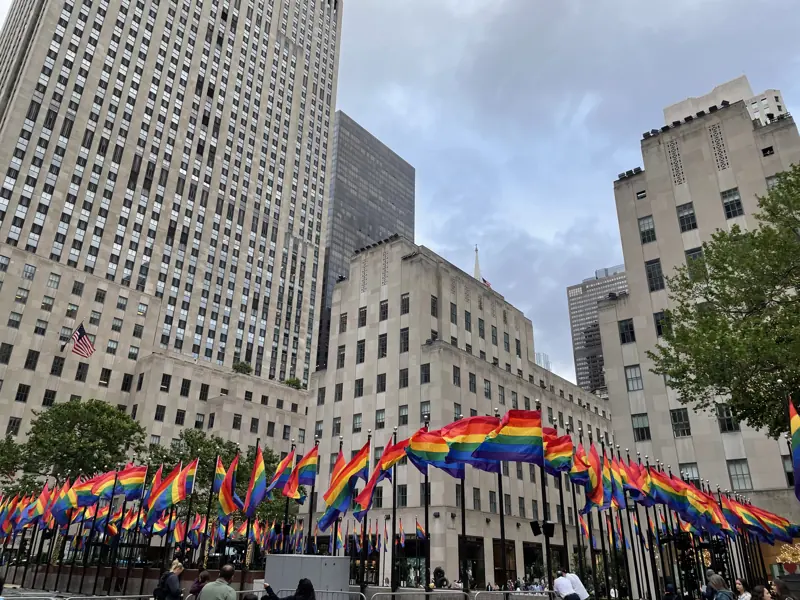
On Sunday, June 28, 1970, the first anniversary, the Christopher Street Liberation Day March assembled on Washington Place, stepped off at noon and went up Sixth Avenue to a 'Gay-In' in Central Park's Sheep Meadow. Craig Rodwell, who had opened the Oscar Wilde Memorial Bookshop in 1967, led the planning with Fred Sargeant, Ellen Broidy and Linda Rhodes. They expected hundreds. Thousands came. Los Angeles marched the same day and Chicago the day before. Every Pride parade on earth is a descendant. Ours is covered on the Pride page.
Not everyone was welcome in the new movement, and the people pushed out said so. In 1970 Sylvia Rivera and Marsha P. Johnson founded STAR, Street Transvestite Action Revolutionaries, and from November 1970 to July 1971 ran STAR House at 213 East 2nd Street in the East Village, a shelter for 15 to 25 homeless trans and queer young people, paid for largely by the two of them. It is among the first organizations of its kind anywhere, and the root of a great deal of what is on our trans NYC page.
The rest of the decade built the furniture of a community: bookshops, newspapers, clinics, discos. Larry Levan's residency at the Paradise Garage on King Street gave a whole genre, garage, its name. The crumbling Hudson River piers at the foot of Christopher Street became a sunbathing deck, a cruising ground, an open-air studio for artists such as David Wojnarowicz, Peter Hujar and Alvin Baltrop, and a refuge for kids with no other address. The Lesbian Herstory Archives began in a Manhattan apartment in the mid-1970s and now fills a brownstone in Park Slope.
The AIDS years: GMHC, ACT UP and a city that buried 100,000
On July 3, 1981, the New York Times reported a rare cancer in 41 gay men. Within a few years the city was the center of the American epidemic, and St. Vincent's Hospital in the Village, home to the first and largest AIDS ward on the East Coast, was its ground zero. More than 100,000 New Yorkers have died of AIDS since.
Government was slow at every level. President Reagan did not give a major speech on AIDS until 1987. So people built their own response. Gay Men's Health Crisis was founded in January 1982 by six men, Nathan Fain, Larry Kramer, Lawrence Mass, Paul Popham, Paul Rapoport and Edmund White, after meetings in Kramer's apartment at 2 Fifth Avenue. Its buddy program, hotline and legal clinic became the template for AIDS service organizations worldwide. The Lesbian and Gay Community Services Center, founded in 1983 in a former school at 208 West 13th Street, gave everyone a room to meet in.
In March 1987, after a furious speech by Kramer at The Center, a room full of people formed ACT UP, the AIDS Coalition to Unleash Power. Its first demonstration shut down Wall Street that same month. It went on to occupy the Food and Drug Administration, interrupt Mass at St. Patrick's Cathedral, and change how drugs are tested and approved in the United States. The 'Silence = Death' poster with its pink triangle was made by a six-person collective shortly before ACT UP existed and handed over to the cause. GLAAD (1985), Queer Nation (1990) and the Lesbian Avengers (1992) were all founded in the same building.
The grief produced art that still stands up: Kramer's play The Normal Heart (1985), Keith Haring's bathroom mural at The Center (1989), Wojnarowicz's Close to the Knives (1991), and Rent, which opened downtown and moved to Broadway in 1996. That same year combination therapy arrived and the death rate finally fell. St. Vincent's closed in 2010. The New York City AIDS Memorial opened on the triangle across the street on December 1, 2016.
Today the conversation is about PrEP, U=U and access. Our sexual health page has the practical side.
Ballroom: houses, mothers and a century of Harlem drag
Modern ballroom grew out of those Harlem masquerades and out of frustration with drag pageants where Black queens rarely won. Crystal LaBeija's on-camera fury at a rigged result in the 1968 documentary The Queen is the origin story; within a few years she had founded the House of LaBeija, and the house system followed. A house is a chosen family with a mother or father, and through the worst of the AIDS years it was often the only family that turned up. Jennie Livingston's Paris Is Burning (1990) filmed the scene in its 1980s prime, and the FX series Pose brought it to television in 2018.
It has never stopped. Houses still walk, voguing is taught in studios from the Bronx to Bushwick, and HIV prevention has met the runway for decades at events such as GMHC's Latex Ball. For where to watch respectfully, see nightlife and drag shows.
Marriage equality in New York (2011), Windsor (2013) and a national monument (2016)
The city passed its gay rights bill in 1986, after 15 years of trying. Marriage took longer. The Marriage Equality Act cleared the State Senate 33 to 29 on the night of June 24, 2011, and Governor Andrew Cuomo signed it before midnight. The law took effect 30 days later, and the first weddings were held on Sunday, July 24, 2011.
The national fight had a Greenwich Village address too. Edie Windsor and Thea Spyer were together for more than 40 years and married in Toronto in 2007. When Spyer died in 2009, the federal government, which did not recognize the marriage, sent Windsor an estate tax bill of $363,053. She sued. On June 26, 2013, in United States v. Windsor, the Supreme Court struck down the heart of the Defense of Marriage Act. She was 84. Two years later to the day, Obergefell v. Hodges made marriage equality national. Windsor died in 2017.
On June 24, 2016, President Obama designated Stonewall National Monument, 7.7 acres taking in Christopher Park and the surrounding streets: the first unit of the National Park Service dedicated to LGBTQ+ history. In June 2019 the city hosted WorldPride for the uprising's 50th anniversary. Police Commissioner James O'Neill apologized for the 1969 raid, saying the department's actions 'were wrong, plain and simple.' Some 150,000 people marched, and organizers estimated around five million visitors over the weekend, the largest Pride gathering held anywhere.
Albany kept moving. New York added gender identity and expression to its human rights law in 2019 and repealed the 'walking while trans' loitering statute in 2021. On June 28, 2024, the Stonewall National Monument Visitor Center opened at 51 Christopher Street, in the half of the original bar that had been lost for decades.
Stonewall National Monument in 2025-2026: the website, the flag, the lawsuit
The newest chapter is about who gets to tell the story. Here is exactly what has happened, as of October 2026.
- February 2025
The 'T' and 'Q' disappear from nps.gov
Following a presidential executive order on gender, the National Park Service removed the words 'transgender' and 'queer' from the Stonewall National Monument website and shortened 'LGBTQ+' to 'LGB'. The Stonewall Inn called it 'a deliberate attempt to erase our history', and protesters filled Christopher Park the next day.
- July 2025
'Bisexual' is cut, then restored
On July 10, 2025, references to bisexual people were also removed, leaving a homepage about 'a gay or lesbian person'. After an outcry the Park Service put 'bisexual' back within days.
- February 2026
The Pride flag comes down
The Park Service removed the rainbow flag from the official flagpole in Christopher Park, citing Interior Department guidance limiting which flags fly on its poles. On February 12 city officials and community members raised a Pride flag again as hundreds watched. Eight days after the removal, Lambda Legal and the Washington Litigation Group sued in Manhattan federal court on behalf of the Gilbert Baker Foundation, Village Preservation and Equality New York.
- April 13, 2026
The government settles
The administration agreed to rehang the Pride flag within seven days and keep it there permanently, flying beside the Park Service flag beneath the Stars and Stripes. The court keeps jurisdiction to enforce the deal.
- May 20, 2026
Named one of America's most endangered historic places
The National Trust for Historic Preservation put Stonewall National Monument on its 2026 list of 11 Most Endangered Historic Places, citing federal actions that threaten accurate interpretation of the site, including the transgender material that had still not been restored.
- October 2026
Where things stand
The flag is flying. The monument's nps.gov homepage describes life for 'a lesbian, a bisexual person or a gay man' and does not use the word transgender. The visitor center next door to the bar, run by the nonprofit Pride Live in partnership with the Park Service, is open and free, Tuesday to Sunday, 10 a.m. to 4 p.m.
The city around the monument has changed as well. Rents pushed much of queer life out of the Village and Chelsea toward Hell's Kitchen, Bushwick, Jackson Heights and beyond; our neighborhoods guide follows where it went. The history stayed put. That is the good news for anyone with comfortable shoes.
LGBTQ+ history of New York: a timeline
- 1869
First Hamilton Lodge Ball
A Black Odd Fellows lodge in Harlem holds the masquerade that becomes the city's great drag ball.
- 1890s
Bowery 'fairy resorts'
Columbia Hall and The Slide make queer nightlife a known, if scandalous, part of downtown.
- 1926
Eve Adams arrested
Police shut down her lesbian-friendly MacDougal Street tearoom; she is deported the following year.
- 1929
7,000 at the Rockland Palace
The Hamilton Lodge Ball hits its peak at 280 West 155th Street.
- 1955
Mattachine Society of New York
The city's first lasting gay rights organization forms; Daughters of Bilitis follows in 1958.
- April 21, 1966
The sip-in at Julius'
Three Mattachine members are refused a drink for the cameras at 159 West 10th Street.
- November 1967
Oscar Wilde Memorial Bookshop opens
Craig Rodwell's shop at 291 Mercer Street is the first gay bookshop on the East Coast. It moves to 15 Christopher Street in 1973.
- June 28, 1969
The Stonewall uprising begins
A raid at 51-53 Christopher Street sets off six days of resistance.
- July and December 1969
GLF and GAA
The Gay Liberation Front forms within weeks; the Gay Activists Alliance splits off before the year is out.
- March 8, 1970
Snake Pit raid
167 arrests, one near-fatal fall and a 500-strong protest march the same night.
- June 28, 1970
Christopher Street Liberation Day
The first Pride march goes from Washington Place to Central Park.
- 1970
STAR founded
Sylvia Rivera and Marsha P. Johnson open STAR House at 213 East 2nd Street that November.
- January 1982
GMHC founded
Six men create the first AIDS service organization.
- 1983
The Center
The Lesbian and Gay Community Services Center is incorporated and buys 208 West 13th Street the following year.
- 1986
City gay rights bill
New York City bans discrimination on the basis of sexual orientation.
- March 1987
ACT UP
Founded at The Center; on Wall Street within the month.
- 1990
Paris Is Burning
Harlem ballroom reaches cinema screens.
- 1992
Gay Liberation unveiled
George Segal's sculpture, commissioned in 1979, is finally installed in Christopher Park. Marsha P. Johnson is found dead in the Hudson that July.
- June 24, 2011
Marriage Equality Act
Passed and signed in Albany; weddings begin July 24.
- June 26, 2013
United States v. Windsor
Edie Windsor of Fifth Avenue beats the Defense of Marriage Act.
- June 23, 2015
Stonewall becomes a city landmark
The first New York City landmark designated for its LGBTQ+ history.
- June 24, 2016
Stonewall National Monument
The first national monument to LGBTQ+ history. The NYC AIDS Memorial is dedicated that December.
- June 2019
Stonewall 50 and WorldPride
The NYPD apologizes; millions come. Six more LGBTQ+ sites, including The Center, the GAA Firehouse and Caffe Cino, become city landmarks.
- December 2022
Julius' landmarked
The sip-in bar gets city protection.
- June 28, 2024
Visitor center opens
51 Christopher Street returns to public use.
- 2025-2026
Website edits and the flag case
Federal edits to the monument's story, a lawsuit, a settlement, and a place on the endangered list.
The people who made queer New York
Gladys Bentley
Blues singer and pianist who performed in a tuxedo at Harlem's Clam House and flirted with the women in the front row. One of the best-known Black entertainers of the 1920s and 30s.
James Baldwin
Born in Harlem, formed in the Village. Giovanni's Room (1956) and Another Country (1962) wrote about love between men with a frankness nobody else was risking. His last New York home, on West 71st Street, is a city landmark.
Lorraine Hansberry
The author of A Raisin in the Sun bought 112 Waverly Place with the proceeds and lived there from 1960 until her death, in a long relationship with a woman tenant, Dorothy Secules.
Dick Leitsch
The Mattachine president who dreamed up the sip-in and fought police entrapment, then spent his later years as a Julius' regular.
Craig Rodwell
Sip-in participant, founder of the Oscar Wilde Memorial Bookshop and the driving force behind the first Pride march. Possibly the most useful person in this whole story.
Stormé DeLarverie
Biracial butch lesbian, drag king and MC of the Jewel Box Revue, Stonewall veteran, and for decades the self-appointed guardian of the Village's lesbian bars.
Marsha P. Johnson
Black trans activist and self-described drag queen from Elizabeth, New Jersey. Stonewall veteran, co-founder of STAR, ACT UP member, Village saint. Her death in the Hudson was first ruled a suicide; friends never accepted it, the cause was later changed to undetermined and the case was reopened in 2012. The 'P' stood for 'pay it no mind'.
Sylvia Rivera
Puerto Rican and Venezuelan trans activist who co-founded STAR at 19 and spent 30 years telling the movement it had left its poorest members behind. The corner of Christopher and Hudson Streets is Sylvia Rivera Way.
Audre Lorde
Harlem-born 'Black, lesbian, mother, warrior, poet' who wrote much of her best work while living on Staten Island and served as New York State Poet.
Larry Kramer
Co-founder of GMHC, catalyst of ACT UP, author of The Normal Heart. Furious, tactless and usually right. He died of pneumonia at 84.
David Wojnarowicz
East Village painter, writer and photographer who documented the piers and then his own illness with unmatched rage. He died of AIDS at 37.
Edie Windsor
IBM programr, Greenwich Village resident, and the plaintiff who brought down the Defense of Marriage Act at the age of 84.
See it for yourself: where to stand in LGBTQ+ history
Almost everything above happened within two miles of Sheridan Square. You can walk it.
Walk the Village
Our self-guided route links Christopher Park, the Stonewall Inn and visitor center, Julius', the NYC AIDS Memorial, The Center and the Christopher Street Pier in about two miles, with add-ons for Harlem, Chelsea and the East Village. LGBTQ history walking tour
Start at the visitor center
51 Christopher Street. Free, no ticket, Tuesday to Sunday 10 a.m. to 4 p.m. There is a working replica of the bar's 1967 jukebox; ask at the desk for a token. Plan a visit
Look things up as you go
The NYC LGBT Historic Sites Project has mapped and documented hundreds of places across all five boroughs, and still runs occasional expert-led walks. NYC LGBT Historic Sites Project
Then read and watch
Chauncey, Kramer, Lorde, Paris Is Burning and the rest are on our shelf. The OUT NYC bookshelf
Frequently asked questions
When and where did the Stonewall riots happen?
The Stonewall uprising began in the early hours of June 28, 1969, when police raided the Stonewall Inn at 51-53 Christopher Street in Greenwich Village, and continued over six days until July 3. The site is now Stonewall National Monument. Today's Stonewall Inn occupies number 53 and the visitor center is at number 51.
Did Marsha P. Johnson throw the first brick at Stonewall?
There is no evidence that any one person threw the first brick, and Johnson herself said she arrived around 2 a.m., after the uprising had started. She was a participant over the following nights and went on to co-found STAR with Sylvia Rivera in 1970. Her importance does not depend on the legend.
What was the first gay rights protest in New York before Stonewall?
The best known is the Mattachine Society 'sip-in' at Julius', 159 West 10th Street, on April 21, 1966, which challenged the practice of refusing to serve gay customers. Julius' is still open and has been a New York City landmark since December 2022.
When was the first Pride march in NYC?
Sunday, June 28, 1970, one year after Stonewall. The Christopher Street Liberation Day March assembled on Washington Place in Greenwich Village and went up Sixth Avenue to Central Park's Sheep Meadow. Thousands took part.
When did New York legalize same-sex marriage?
The Marriage Equality Act passed the State Senate and was signed on June 24, 2011, and took effect on July 24, 2011, when the first weddings were held. New Yorker Edie Windsor's Supreme Court victory over the Defense of Marriage Act followed on June 26, 2013.
Is the Pride flag flying at Stonewall National Monument?
Yes, the Pride flag is flying at Stonewall National Monument again. The National Park Service removed it in February 2026, but under a court-enforceable settlement reached on April 13, 2026, the Pride flag was restored to the monument's official flagpole in Christopher Park and is to remain there permanently.
Did the National Park Service remove transgender people from the Stonewall website?
Yes, the Park Service removed transgender people from the Stonewall website: in February 2025 the words 'transgender' and 'queer' were removed from the Stonewall National Monument pages on nps.gov. 'Bisexual' was removed and then restored in July 2025. As of October 2026 the homepage still does not mention transgender people, which is one reason the National Trust listed the monument as endangered in May 2026.
Where did ballroom culture start?
Ballroom culture started in Harlem. Its roots go back to the Hamilton Lodge masquerade balls, first held in 1869, which drew about 7,000 people to the Rockland Palace in 1929. The modern house system began with Crystal LaBeija and the House of LaBeija around 1970.
Keep exploring
 Walking TourThirteen stops, about two miles, and most of a century of queer history, from the park where the uprising…
 West VillageThe Stonewall Inn, Julius' (the oldest gay bar in the city), two of the last lesbian bars in America and a…
 NYC PrideThe NYC Pride March is the last Sunday in June, which makes it June 27 in 2027. Here is what is confirmed,…
 HarlemHarlem threw drag balls for thousands of people forty years before Stonewall. Today it has one of the city's…
 BookshelfA reading and watching list for anyone who wants to understand queer New York before they arrive, or finally…
 Trans NYCNew York remains one of the safest places in the country to be trans, and one of the best resourced. Here is…